The software desk
Latency is the headline. The swim path is the story.
A video course on the water maze and five other classic tests, told through what the tracker actually records.
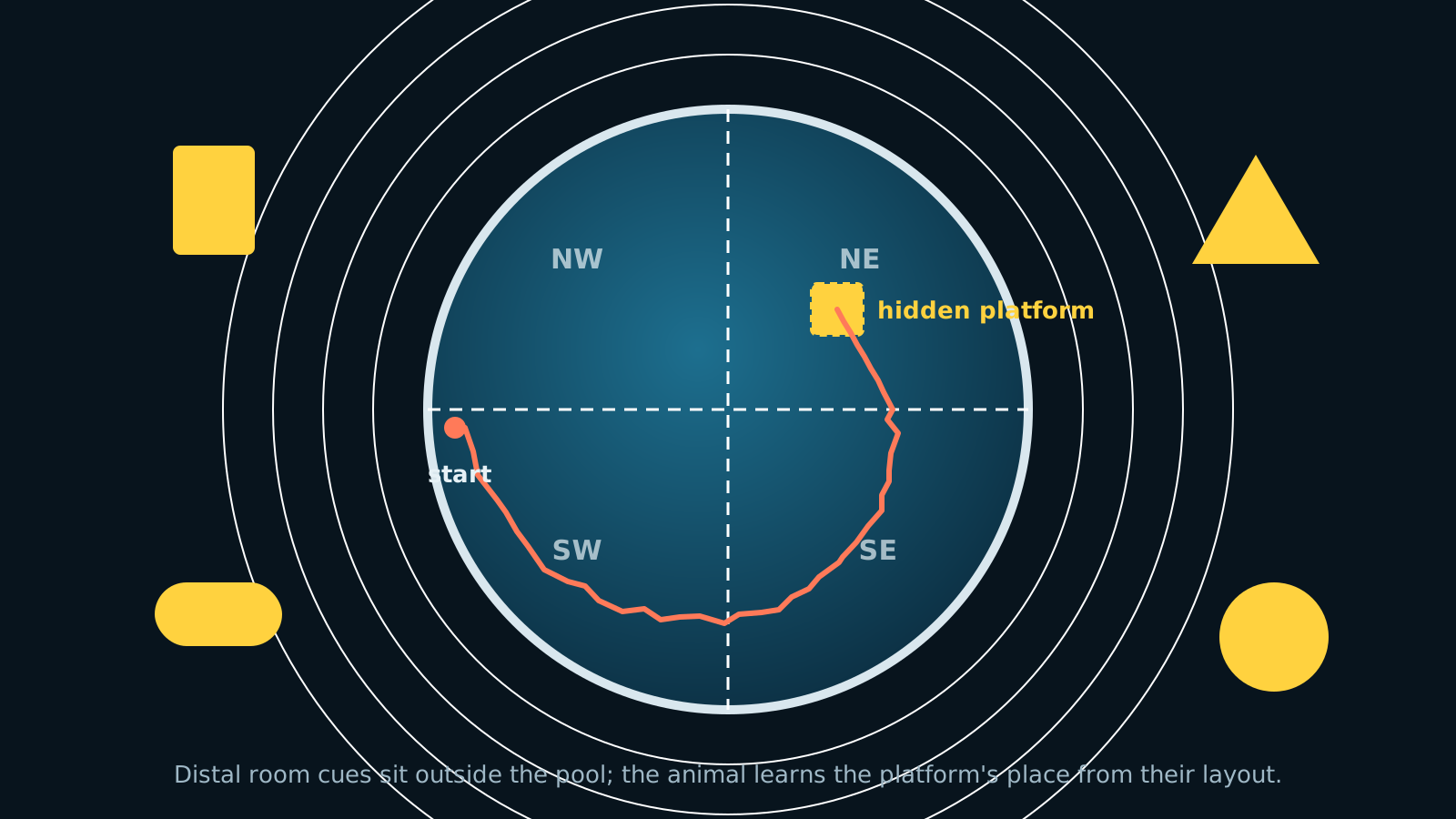
Image: credit
Every water maze trial ends with a number, usually seconds to platform. It's a fine number. It just can't tell you whether the animal remembered the place or simply worked out that circling at the right distance from the wall gets the job done.
These six short films walk through the water maze, radial arm, open field, T-maze and Barnes maze, then get stuck into the analysis: heading, proximity, thigmotaxis, chaining and strategy. Each page carries the full script, chapters and a shot list, so you can read along or skip ahead.
Explore
On this site
Choosing water maze software without regrets
A practical checklist for Morris water maze software: tracking quality, analysis depth, strategy detection, calibration and open data export.
Morris water maze
How does a pool of cloudy water tell us whether a rat has a map in its head?
Virtual Morris water maze
Can we put a person in the same test we give a rat, without the water?
Radial arm maze
How do we tell working memory from reference memory in one test?
Open field test
What can an empty box tell us about anxiety and movement?
T-maze
How does one left-or-right choice reveal memory?
Barnes maze and other HVS-tracked mazes
What if you want a spatial test without swimming?
Probe trial
What happens when we take the platform away, and why is that the real memory test?
Thigmotaxis measure
Why does an animal hug the wall, and why does that matter for your memory data?
Search strategy analysis
Two animals reach the platform in the same time. How can one have learned it and the other not?
Y-maze
How does a three-armed maze reveal working memory in a few minutes?
Gallagher proximity measure
Why is the average distance from the goal such a powerful memory score?
Cumulative search error
How do we score a search fairly when every swim starts from a different place?
Reversal learning test
Can an animal let go of an old answer and learn a new one?
Novel object recognition test
How do we know a mouse remembers an object it saw yesterday?
Elevated plus maze
How does a raised cross of four arms measure anxiety-like behaviour?
Atlantis platform
What if the platform only rose when the animal searched in the right place?
Escape latency
Why does a short swim time not always mean a good memory?
Path length and swim speed
How do we tell a shorter search from a faster swim?
Place versus cued trial
How do we know an animal is using a map, and not just swimming towards something it can see?
Barnes maze escape error
If a mouse finds the escape hole quickly, how do we know it did not just check every hole on the way?
Spatial object recognition
How do we test whether an animal remembers where an object was, not just what it looked like?
Spontaneous alternation
Why does a rodent so often turn into the arm it did not visit last time?
Zone and quadrant analysis
Once we divide the pool into regions, what do those regions actually tell us?
Heading angle
If we only watch the first seconds of a swim, what can the animal's direction tell us?
Watch
Latest films
Our two newest maze explainers. Every film has its own page with the full script; see all the videos.
Virtual Morris water maze
Plays from YouTube in privacy-enhanced mode, only when you press play. Watch on YouTube.
Can we put a person in the same test we give a rat, without the water? Script, chapters and sources (2:48).
Morris water maze
Plays from YouTube in privacy-enhanced mode, only when you press play. Watch on YouTube.
How does a pool of cloudy water tell us whether a rat has a map in its head? Script, chapters and sources (3:33).
From the journals
Recently in the pool
SfN booth notes on HVS Image plus three maze studies. Our rewrites, their originals.
At SfN San Diego, the maze met the booth
The Neuroscience 2025 exhibitor page for HVS Image (booth 2019, San Diego Convention Center, 16 to 19 November 2025) puts Morris water maze expertise front and centre, alongside video tracking billed as fast, precise and effortless, a VR Morris water maze for humans that links rodent and human work, and immersive VR tools for cognition, movement and rehabilitation. The booth copy traces the line from the company's early pioneering maze work to measures and automated analyses meant to show how animals learn, remember and choose a strategy, and it flags HVS Image 2026 for MWM and other tests as a conference release. Visitors were invited to try MWM and hyper-realistic human scenes in HVS 6D VR on the stand.
Read the original at Neuroscience 2025 (SfN)Too much salt, and older mice lose their way
Twelve-month-old male mice ate chow with 8% salt or a normal 0.5% for two months, ten per group, with testers blinded. The salty group learned the water maze more slowly, with gaps opening on days four and five, and did worse on every probe measure: crossings, time over the old platform spot, distance and target-quadrant time. Swim speed and open-field behaviour didn't differ, which is exactly the control you want before calling it a memory effect. The authors link the deficit to more amyloid-beta and a mitochondrial clean-up response that tried, and failed, to keep up. Published in Frontiers in Neurology.
Frontiers in Neurology
Read the original at Bioengineer.orgIcariin and the stressed nucleolus
Icariin, the main active compound of the herb Herba Epimedii, was tested in APP/PS1 mice and in cultured microglia. In the water maze (four trials a day for four days, then a probe and a contraposition exploration test), treated mice crossed the old platform spot more often and swam distances closer to healthy controls, though the time to find the platform didn't clearly improve. The authors connect the effect to relief of nucleolar stress, the cell's ribosome factory under strain.
Read the original at Bioengineer.orgAfter blood loss and rescue, memory hinges on microglia
Male mice that survived haemorrhagic shock and resuscitation were tested on object recognition at day 31 and in the water maze from day 32. They took longer to find the platform, crossed its old spot less and spent less time in the target quadrant, while swimming at normal speed. Blocking the NLRP3 inflammasome in microglia brought performance back. Published in Behavioral and Brain Functions.
Behavioral and Brain Functions
Read the original at Bioengineer.org